






Eka Robotics, a startup developing artificial intelligence models that help robots handle physical objects with human-like precision, has raised $150 million in a Series A funding round at a post-money valuation of $1.45 billion, as investors bet on a breakthrough in robotic manipulation.
The funding round, led by venture capital firms Andreessen Horowitz (a16z) and F-Prime, will support the company’s efforts to develop robots that can grasp, move and manipulate objects without relying solely on visual data or extensive human demonstrations.
Founded by Massachusetts Institute of Technology professor Pulkit Agrawal and former Google DeepMind researcher Tuomas Haarnoja, Eka is pursuing a different approach to robotics by combining force-sensitive hardware with reinforcement learning models trained through physics-based simulations.



The technology addresses one of the industry’s persistent challenges: enabling robots to handle delicate, irregular and unfamiliar objects without damaging them.
While advances in artificial intelligence have improved robots’ ability to recognise objects and plan tasks, executing those plans in the physical world remains difficult. A robot may identify a raspberry or a plate correctly but still crush it, drop it or fail to grasp it securely.
Eka is attempting to close that gap by teaching robots to respond to physical contact rather than depending primarily on cameras to guide every movement.
Force-sensitive technology sets Eka apart
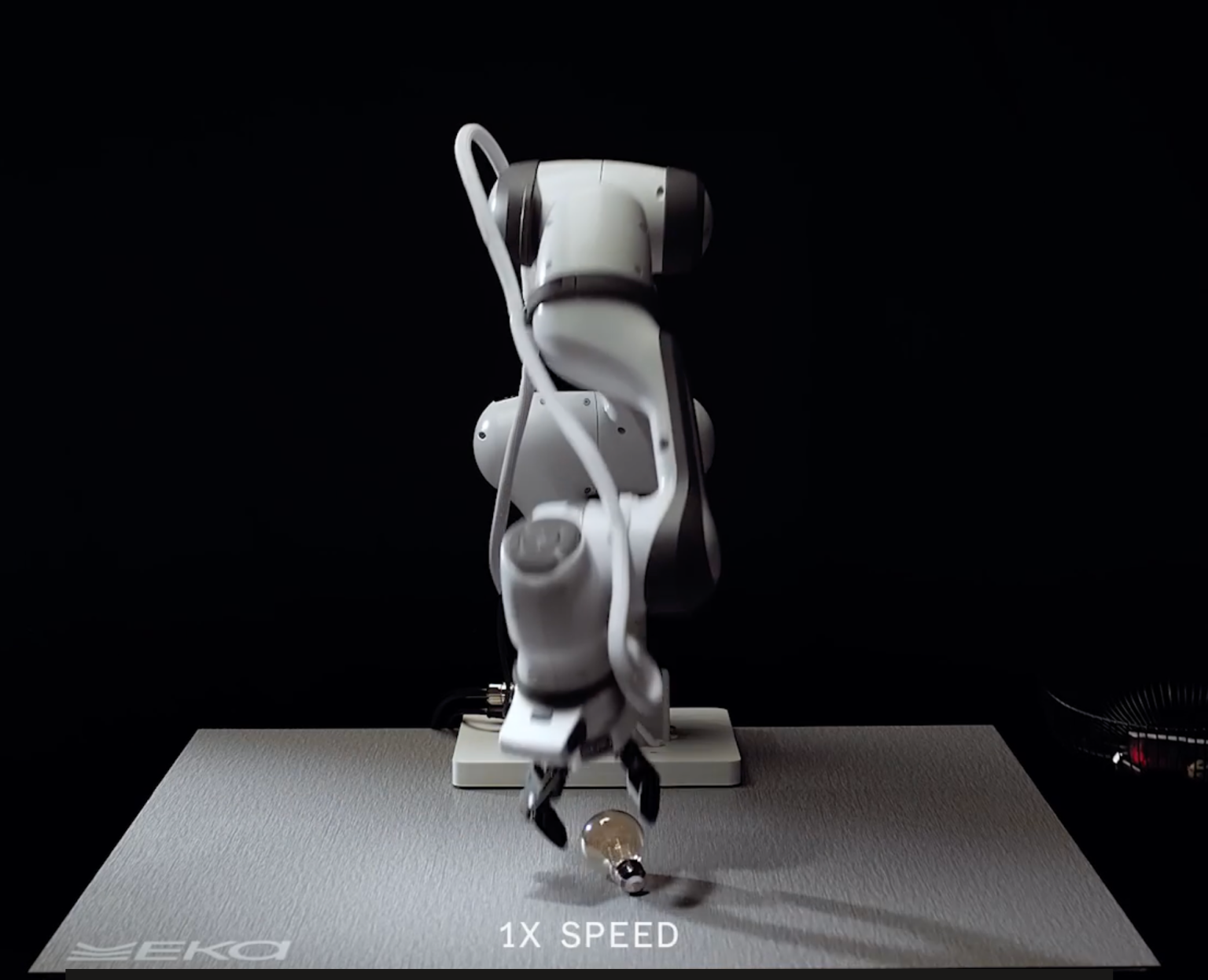
The company’s robotic hand uses a flexible gripper equipped with force sensors that allow it to adjust its movements when it encounters an object.
Instead of relying exclusively on visual information to determine how to pick something up, the robot uses tactile feedback to detect contact, assess resistance and refine its grip.
Eka co-founder Agrawal said vision could identify an object’s approximate position and orientation, but forces play a more important role in the final stages of grasping.
The approach could prove particularly useful in environments where robots must handle fragile produce, irregularly shaped components, electrical wires and other objects that require careful manipulation.
According to Raghu Raguram, an a16z general partner who co-led the investment, Eka’s technology already exceeds human performance in certain tasks, with further improvements expected across dexterous manipulation.
The company’s demonstrations have also attracted attention from researchers who have watched the robotics industry struggle to achieve reliable physical interaction.
Kris Hauser, a professor at the University of Illinois Urbana-Champaign, said the robot impressed him because it adapted to numerous objects without requiring retraining for each one.
Hauser also observed that the machine repeatedly attempted to complete tasks after failing, an ability that could make robots more resilient when operating in unpredictable environments.
These demonstrations suggest that Eka may be moving beyond robots that simply repeat carefully programmed actions towards machines that can adjust their behaviour when physical conditions change.
Simulation could reduce the cost of training robots
A central part of Eka’s strategy is its use of reinforcement learning and physics-based simulation to generate training experience at scale.
Traditional robotics training often depends on human demonstrations, recorded videos or operators spending hours teaching machines how to perform specific tasks. Those methods can limit the range of situations a robot encounters before deployment.
Eka instead uses simulations to model the forces a robot experiences when interacting with different objects. Its reinforcement learning system then uses those simulated experiences to improve how the robot grasps and manipulates items.
The founders say the approach allows the company to generate thousands of hours of robotic experience in minutes.
This could reduce the time and expense required to develop systems capable of handling new objects and unfamiliar physical conditions.
Hauser said the approach could help robots move beyond the limitations of human-provided training data, allowing them to develop capabilities through repeated simulated experience.
For manufacturers, the potential advantage is significant. A robot that can learn to handle different components without extensive retraining could reduce deployment costs and make automation practical for a wider range of production tasks.
However, the value of simulation depends on how accurately it reflects real-world conditions. Friction, material deformation, sensor noise and mechanical wear can behave differently outside a virtual environment, meaning developers must still demonstrate that simulated learning translates into reliable physical performance.
Eka targets industrial automation
Eka is developing its technology for industrial applications, including pick-and-place operations and wire manipulation. The company is conducting pilots with industrial customers but has not yet demonstrated that its approach can operate reliably across a broad range of commercial production environments.
Its immediate strategy focuses on proving the technology in selected applications before expanding into more complex workflows.
This is a pragmatic approach in an industry where impressive laboratory demonstrations do not always translate into commercially viable products.
Factories require equipment to operate consistently across long shifts, withstand repeated movements and minimise downtime. Even a highly capable robot can struggle to justify its cost if it requires frequent repairs, specialist supervision or extensive adjustments whenever manufacturers change production tasks.
Hauser identified long-term reliability on actual assembly lines as one of Eka’s major challenges. He also questioned how effectively its techniques would transfer from picking and placing objects to more complicated industrial activities.
Agrawal said the company’s gripper hardware currently costs less than $1,000 and is rated for five million duty cycles. Eka ultimately wants to reach 20 million cycles, a benchmark Agrawal associated with standard industrial robotic arms.
Achieving that target would strengthen the company’s case for adoption in demanding manufacturing environments, where equipment durability directly affects operating costs.
A different approach to physical AI
Eka’s strategy reflects a broader shift in robotics research. Rather than focusing exclusively on building more capable general-purpose AI models that plan and reason about tasks, the company is concentrating on the physical skills robots need to execute those plans.
For example, a general-purpose AI model might determine that dishes should go into a cupboard after a dishwasher finishes its cycle. Eka’s technology aims to provide the dexterity required to pick up each dish, control the applied force and place it safely.
The distinction matters because reasoning about a task and physically completing it are separate technical challenges.
A robot may understand what it needs to do but still fail because it cannot coordinate its movements, respond to contact or adapt when an object shifts unexpectedly.
By tackling manipulation as a core capability, Eka hopes to make general-purpose robots more practical in environments where objects, layouts and operating conditions vary.
The company’s founders believe this bottom-up approach could help address the gap between robots that can attempt many tasks and those that can perform them reliably.
What Eka’s $1.45bn valuation means
Eka’s valuation highlights investors’ growing interest in AI systems that can interact reliably with the physical world, rather than simply generate text, images or software.
However, the funding announcement does not establish that the company has solved general-purpose robotics. Its technology must still demonstrate consistent performance outside controlled settings, particularly in industrial environments where reliability, maintenance and throughput determine commercial success.
For manufacturers, the more important question is not whether a robot can complete an impressive demonstration, but whether it can perform the same task thousands or millions of times without damaging products or interrupting production.
Eka’s focus on force feedback and simulation offers a potential route towards that goal. Its comparatively inexpensive gripper could also help reduce the hardware costs associated with deploying dexterous robots, provided the system delivers sufficient durability and performance.
The company is therefore pursuing two distinct milestones: proving that its models can generalise across unfamiliar objects and proving that its hardware can withstand sustained industrial use.
Success on both fronts could open the door to broader applications in manufacturing, electronics assembly, food processing and other industries that require precise handling.
For now, Eka has attracted substantial investor backing and strong interest from robotics researchers. Its next challenge is to turn that promise into dependable factory performance.
For TechMarge, the bigger story is the shift from AI that understands instructions to AI that can execute them physically. If Eka can translate its laboratory results into reliable industrial operations, its technology could help make flexible automation more accessible. But until the company demonstrates that performance at scale, its $1.45 billion valuation remains a bet on what physical AI might become rather than proof that the robotics problem has been solved.