



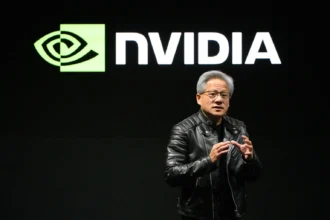
Nvidia CEO Jensen Huang arrived in South Korea for the first time in fifteen years to reveal new projects and strengthen partnerships with top Korean technology companies such as Hyundai Motor, Samsung, SK, and Naver. During the APEC Summit 2025, Nvidia and the South Korean government announced an expanded collaboration aimed at advancing the country’s AI infrastructure and driving growth in physical AI technologies.
The visit came just after the United States signed fresh technology agreements with Japan and South Korea, designed to tighten cooperation on artificial intelligence, semiconductors, quantum computing, biotechnology, and 6G communication systems.
South Korea revealed plans to acquire more than 260,000 of Nvidia’s newest GPUs to power its growing AI ecosystem. Around 50,000 GPUs will support public projects, including building domestic AI foundation models and establishing a national AI data center. The rest, more than 200,000 GPUs, will go to companies like Samsung, SK, Hyundai Motor Group, and Naver to fuel AI-driven manufacturing innovation and the creation of specialized industry AI models.
Samsung took a major step by announcing its partnership with Nvidia to construct an AI Megafactory. The project will integrate AI at every level of semiconductor, mobile device, and robotics production. Equipped with over 50,000 Nvidia GPUs and running on Nvidia’s Omniverse platform, the facility will analyze, predict, and optimize operations in real time. Samsung and Nvidia have worked together for more than two decades, and their current collaboration extends to developing HBM4, the next generation of high-bandwidth memory built to power future AI applications.
Nvidia also teamed up with Samsung, South Korea’s major telecom operators, SK Telecom, KT, and LG Uplus and ETRI, the Electronics and Telecommunications Research Institute, to co-develop AI-RAN technology. AI-RAN enhances mobile base station performance while reducing power consumption. Under a new agreement, Nvidia will work with South Korea’s industry and research bodies to create next-generation AI-RAN systems and build a global testing platform for them.
In October, Nvidia announced that Samsung Foundry would help produce custom CPUs and XPUs. This partnership follows Nvidia’s collaboration with Intel to connect x86 CPUs directly to Nvidia’s platforms through NVLink Fusion.
Hyundai Motor Group joined forces with Nvidia to expand AI infrastructure and strengthen physical AI technologies. Their focus lies in autonomous mobility, robotics, and smart factories. Together, they plan to use 50,000 Nvidia Blackwell GPUs for integrated AI model training, validation, and deployment. They also intend to set up AI research centers in South Korea to advance the physical AI industry.
Jensen Huang described the collaboration as a milestone that redefines how industries operate. He said AI is reshaping every sector, especially transportation, from vehicle design to manufacturing and autonomous driving. He emphasized that Nvidia and Hyundai aim to create intelligent cars and factories that will define the future of the multitrillion-dollar mobility industry.


SK Group, which owns SK Hynix, partnered with Nvidia to develop Asia’s first enterprise-led manufacturing AI cloud. The platform will rely on Nvidia’s simulation and digital twin technologies, offering access to the South Korean government, public institutions, and local startups.
Naver Cloud, part of the country’s largest search engine, is working with Nvidia to develop a next-generation Physical AI platform. This system will link the physical and digital worlds, supporting industries such as semiconductors, shipbuilding, energy, and biotechnology. Naver’s goal is to speed up the integration of AI technologies optimized for real-world industrial use.
Naver founder Hae-jin Lee described this transition as the dawn of a new era. He said the world is moving toward “Physical AI,” where artificial intelligence functions directly in industrial environments and systems.
The series of collaborations between Nvidia and South Korea’s top corporations, Samsung, Hyundai, SK, and Naver, illustrates a larger global shift where AI and hardware innovation merge to transform industries. These projects highlight how global technology leaders are shaping the next generation of intelligent systems through strategic cooperation.
Earlier in the week, Nvidia revealed a wave of new partnerships with companies such as Eli Lilly, Palantir, Uber, Joby Aviation, and Hyundai, as well as the U.S. Department of Energy. Huang downplayed fears of an AI bubble, and the announcements pushed Nvidia’s stock to new heights, making it the first publicly traded company to surpass a $5 trillion market value.